Finding the right flowers for your home or garden can be very challenging. Not only do you have to think about seasonality, but you have to consider color, climate, environment, sunlight, and more. In this article, gardening enthusiast Jason Wilson walks through over three hundred different types of flowers to consider adding to your landscape.

Picking the best flowers for your outdoor space can be tricky, but not anymore! In this guide, you’ll learn about 301 different types of flowers to help you choose the best blooms for your gardens.
Whether you’re looking for pretty perennials, awesome annuals, or stunning shrubs, we have something for every gardener and garden. Many of these flowers are quite unique in both their color and the environments they thrive in.
We decided to focus primarily on specific flower species. But for those larger groups, we have described the genus, complete with some excellent cultivars for you to choose from. So, let’s take a look at our list of favorite flowers for your garden, in alphabetical order.
Achillea Desert Eve™ ‘Deep Rose’

Scientific Name: Achillea millefolium ‘Desert Eve™ Deep Rose’
Part of the Desert Eve™ Series, this is one of the earliest blooming yarrows. It is a wonderfully bright herbaceous perennial that produces large clusters of bright pink flowers. It blooms profusely in late spring for several weeks, and each flower has a fluffy yellow center.
These types of flowers are aromatic, semi-evergreen, and complement most other blooms in any setting. Butterflies adore all yarrows, so this is a must for any wild or cottage garden.
African Daisy

Scientific Name: Osteospermum spp.
This is an excellent type of flower for anyone looking for bright, beautiful blooms throughout summer and into fall. There are around 70 species of Osteospermum and an increasing number of cultivars. The Royal Horticultural Society (RHS) lists about 900 varieties.
One stem carries a single flower, comprising a central disc surrounded by bright petals. The petals of some species are variegated in color, offering the most stunning blooms. Most petals are flat, but some produce spoon-shaped petals, such as the Osteospermum ‘Sunny Philip’. Depending on what zone you live in, different species can be annuals or perennials, and you can grow them from seed.
African Lily
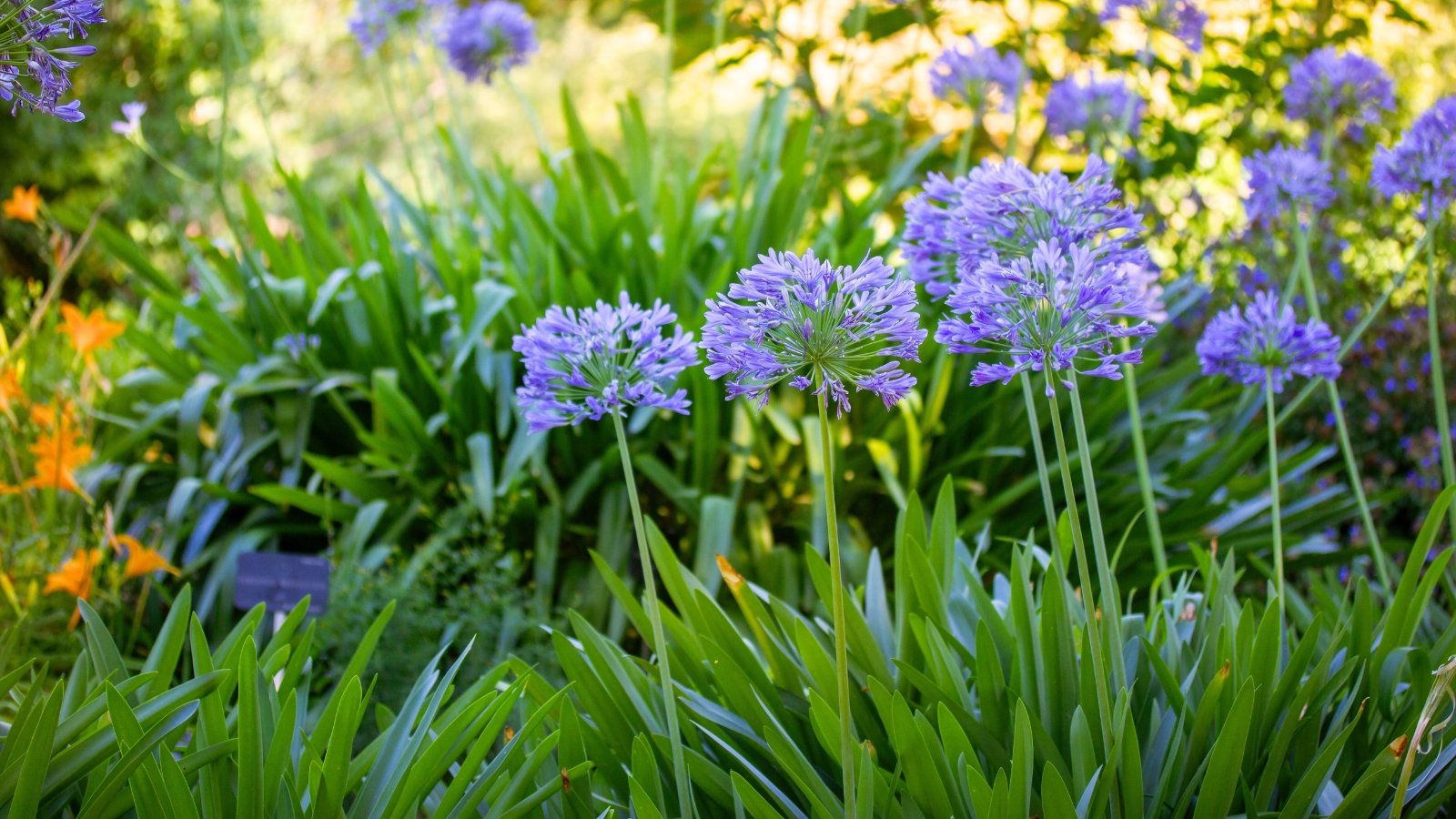
Scientific Name: Agapanthus africanus
Other names of Agapanthus africanus include the Star of Bethlehem or the Lily of the Nile. These evergreen perennials reach up to one meter in height and produce erect stems bearing a globe-shaped display of blue, lilac, or white blooms. Each globe has showy trumpet-shaped flowers that thrive in open sunlight. They also do well in salty sea winds, making them ideal for a coastal garden.
African Marigold

Scientific Name: Tagetes erecta
Tagetes erecta is a bushy annual prized for its large double flowers. Each blossom measures two to four inches across and comes in orange, yellow, and white shades. They are long-blooming from early summer until the first frost, and they only need minor assistance to thrive. They are ideal for beds, borders, and patio pots.
African Violet

Scientific Name: Streptocarpus ionanthus
African violets are one of the most popular plants for indoor gardens. Most species naturally live in the mountains, usually under the cover of other plants. Because of this, they require moderate temperatures and light, both of which are easy to control inside homes. However, some indoor gardeners shy away from growing them because their care can be intimidating.
These plants come in almost every color and have a frilly or fringed texture to the petals. They will bloom nearly every day if in bright and dependable lighting. The foliage is typically green or variegated, with a slight fuzz in texture.
Alpenrose

Scientific Name: Rhododendron ferrugineum
This upright evergreen shrub (Rhododendron ferrugineum) produces glossy, dark-green leaves and clusters of tubular, rose-pink to crimson flowers. It blooms in early summer and grows with a compact, upright habit.
These types of flowers can grow up to five feet high, looking great in the rear of borders and at the side of water gardens. It prefers full sun to partial shade and is hardy in zones 4 to 9.
Amaryllis

Scientific Name: Hippeastrum spp.
This is a popular bulb given as a gift around the Christmas holidays, thanks to its large, brightly colored blooms supported by large stems. There are five types of amaryllis flowers: large-flowering, double-flowering, small-flowering, cybister, and trumpet. The most popular is the large, flowering, single flower amaryllis, which grows up to 10 inches tall.
The bigger the bulb, the more stems and flowers it produces. They may be planted outdoors (deep south only) and are easy to bring into bloom. ‘Amaryllis Clown’ is an award-winning old favorite that is reminiscent of candy canes.
American Lotus

Scientific Name: Nelumbo lutea
This might not be as popular as the Sacred Lotus that is more often seen in cultivation. But these types of flowers provide a blanket of elegance thanks to their pure white petals and a yellow center. They grow up to 12 inches across and are a sight to behold. It is a marginal aquatic perennial that also produces large umbrella-like leaves. They are native to eastern North America.
American Wisteria

Scientific Name: Wisteria frutescens
American wisteria (Wisteria frutescens) is a vigorous climber with twining stems, blooming from late spring through to summer. It forms drooping six-inch-long clusters of pea-like lilac-colored flowers that also give off a delightful aroma. American wisteria is less damaging to structures than Chinese or Japanese species. It grows up to 30 feet tall and requires a solid structure to support itself once it matures because it can become quite heavy.